| Availability: | |
|---|---|
| Quantity: | |
LY-S2K
Liyi
LY-S2K
The LY-S2K conventional temperature and humidity controller is a high-performance environmental regulation device independently developed by Zhejiang Liyi Technology Co., Ltd. , with humidity control as its core function and dual-sensor redundancy design as its highlight. It is tailored for scenarios requiring stable humidity environments, aiming to solve problems such as product deterioration, equipment failure, and experimental data deviation caused by humidity fluctuations. The product adheres to the design concept of "precision, reliability, and versatility," integrating industrial-grade durability with user-friendly operation to meet the needs of multiple industries.
The LY-S2K supports two operational modes to adapt to different usage scenarios: Automatic Mode (the default mode for daily use) automatically adjusts humidity based on preset thresholds without manual intervention; Manual Mode allows users to directly control humidity-regulating equipment (e.g., dehumidifiers, humidifiers) for emergency adjustments or special process requirements. The seamless switching between the two modes ensures flexibility and stability in humidity management.

With a humidity accuracy of ±5%RH and a control backlash range of 0~20%RH, the LY-S2K can stably maintain the target humidity range, avoiding sudden humidity changes that affect sensitive products or experiments. Its temperature monitoring accuracy of ±0.5℃ also provides auxiliary data support for comprehensive environmental regulation.
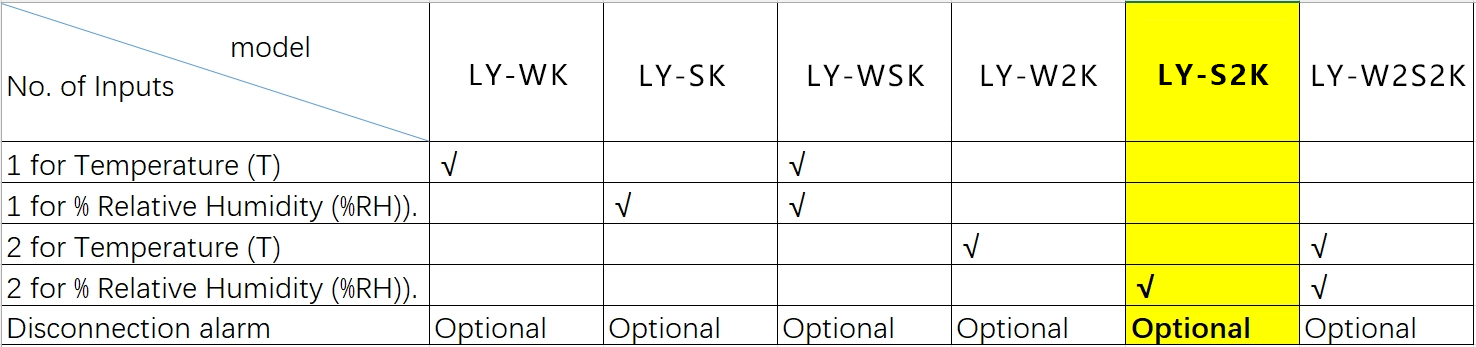
Equipped with Dual Humidity Sensors (Sensor 1 & Sensor 2), the controller achieves redundant monitoring: if one sensor malfunctions, the other immediately takes over to ensure uninterrupted control—critical for high-risk environments like pharmaceutical storage and electronic component workshops. Additionally, the built-in real-time humidity alarm system triggers alerts promptly when humidity deviates from set values, enabling users to respond quickly and reduce losses.
Boasting low power consumption (<2W), the LY-S2K is suitable for 24/7 continuous operation, significantly reducing long-term energy costs for enterprises. Its industrial-grade build can withstand harsh working conditions (operating temperature: -20℃~70℃; relative humidity ≤95%RH), and the compact size (48×48×78mm³) saves valuable installation space in control cabinets or equipment racks.
The LY-S2K’s technical parameters are optimized for humidity control, with key highlights including: compatibility with standard industrial power supplies (AC 220±10% 50Hz), a wide humidity control range (0~99%RH), and a dual working voltage load capacity of 3A—supporting most common humidity-adjustment devices. Its 1000V AC pressure resistance (50Hz, 1 minute) ensures electrical safety in complex industrial circuits.
| Working Power | AC 220±10%,50HZ |
| States of use | Temperature -20℃~70℃;Relative humidity≤95%RH |
| range of control | Temperature -9℃~99℃;Humidity 0~99%RH |
| accurate | Temperature 0.5℃;Humidity 5%RH |
| Control backlash | Temperature 0~20℃;Humidity 0~20%RH |
| load capacity | Double working voltage 3A |
| pressure resistance | 50Hz, 1000V rotating current term 1 min |
| power consumption | <2w |
| volume | 48✖48✖78mm3 |
In grain depots, fruit warehouses, and cold storage facilities, the LY-S2K maintains optimal humidity (e.g., 6070%RH for grains, 8590%RH for fruits) to prevent mold growth, moisture loss, and spoilage, effectively extending the food shelf life and reducing waste.
In semiconductor, circuit board, and electronic component production workshops, the controller regulates humidity to 45~65%RH, avoiding static electricity generated by low humidity that can damage sensitive electronic components, thus ensuring product quality stability.
For biological culture, material aging tests, and chemical experiments that require precise humidity, the LY-S2K provides a stable environment, ensuring the repeatability and reliability of experimental data, making it an essential auxiliary device for research institutions.
Integrated with central air conditioning and ventilation systems in shopping malls, office buildings, and hotels, the controller adjusts indoor humidity to a comfortable range (40~60%RH), improving indoor air quality and enhancing human comfort.
Choose the LY-S2K if your application requires dual-zone humidity monitoring (e.g., separate storage zones in a warehouse) or high-precision humidity regulation (±5%RH). It is not recommended for scenarios where temperature control is the primary focus (opt for the LY-W2K instead).
Pair the controller with the ALE-S2K input module (specifically designed for 2 humidity inputs) to enhance signal transmission stability and data accuracy. For wiring convenience, select compatible sensor extension cables (≤5m) to avoid signal attenuation.
For critical applications (e.g., pharmaceutical storage, precision electronics production), add the disconnection alarm function to receive timely alerts if sensors or connecting wires fail, preventing unmonitored humidity deviations.
Power Connection: Connect AC 220V power to terminals 6-10 (AC input) and terminal N (neutral wire); ensure correct wiring to avoid short circuits or equipment damage.
Sensor Installation: Mount Sensor 1 and Sensor 2 in representative areas (avoid direct sunlight or air vents) and secure wiring to prevent loose connections.
Threshold Setting: Press the "Auto/Manual" button to enter setup mode; use the adjustment keys to set the upper and lower humidity limits (e.g., 40%RH lower limit, 60%RH upper limit) and confirm.
Mode Selection: Use "Auto Mode" for daily operation; switch to "Manual Mode" only for emergency adjustments (e.g., sudden humidity spikes), and revert to auto mode once the issue is resolved.
Sensor Calibration: Calibrate both sensors every 6~12 months using a standard humidity calibrator to ensure measurement accuracy.
Alarm Testing: Monthly test the alarm function by adjusting humidity beyond preset thresholds to confirm the alert works normally.
Cleaning & Inspection: Regularly wipe the sensor surface to remove dust; check wiring terminals quarterly for looseness or corrosion.