| Availability: | |
|---|---|
| Quantity: | |
Accurate and reliable power measurement is essential for effective energy management, cost control, and equipment performance monitoring in industrial and commercial facilities. The LY-300XE three-phase multifunctional power meter is a next-generation miniature device designed to meet these needs, offering comprehensive electrical parameter measurement and seamless system integration.
This rail-mounted three-phase power meter features a clear LCD display and energy pulse output, along with an RS485 communication interface that enables data exchange with host computers and building management systems. Compliant with international standards, it delivers high-precision measurements in a compact form factor, making it ideal for space-constrained installations. Whether used for industrial process monitoring or commercial building energy management, it provides actionable data to optimize energy usage and reduce operational expenses.
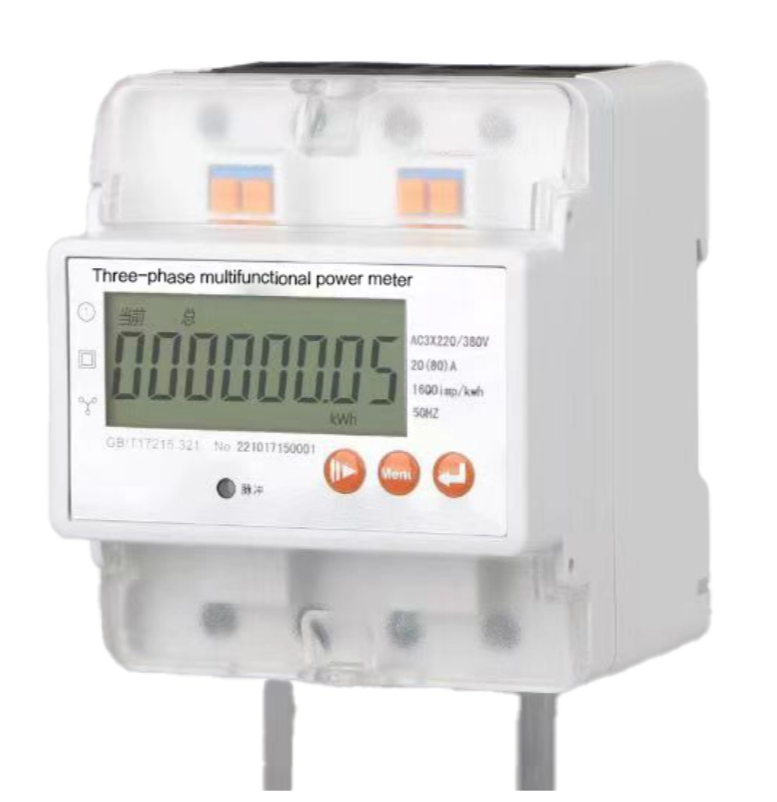
With an energy accuracy class of 1.0 level, this industrial power monitoring meter accurately measures and records electrical energy consumption from 0 to 999999.9 kWh. Its low starting current of 0.004Ib ensures accurate measurement even at very low load conditions, eliminating energy waste and ensuring fair billing.
The device measures all critical electrical parameters including voltage (U), current (I), active power (P), reactive power (Q), and frequency (F), in addition to three-phase energy metering. The 7-segment LCD display presents information in easy-to-navigate pages, providing real-time visibility into system performance and energy usage patterns.
This digital energy meter with RS485 supports both Modbus-RTU and DLT645-2007 communication protocols, allowing easy integration with existing power monitoring systems, SCADA platforms, and energy management software. This compatibility enhances system connectivity and enables centralized data collection and analysis.
Adopting the standard 35mm DIN rail mounting method, installation is fast and requires no special tools. The compact dimensions (126×97×76mm) save valuable panel space, making it suitable for installation in distribution boards, control panels, and electrical cabinets of all sizes.
Industrial Process Monitoring: Used in manufacturing plants, factories, and production facilities to monitor the power consumption of individual machines and production lines. This data helps identify energy-intensive processes and implement efficiency improvements.
Commercial Building Energy Management: Ideal for office buildings, shopping centers, and residential complexes to measure and manage electricity usage across different floors, tenants, and departments. It facilitates accurate billing and helps reduce overall energy costs.
Power Grid Substations: Collects and transmits real-time power data from distribution substations, providing grid operators with critical information for load management, fault detection, and preventive maintenance.
Current Rating: Select a current specification slightly higher than the maximum normal operating current of the circuit. For currents exceeding 80A, use an external 5A current transformer in conjunction with the 1.5(6)A meter model.
Voltage Requirement: Ensure the meter's rated voltage (AC 3×220/380V) matches the system voltage of your installation.
Communication Needs: If remote monitoring and data integration are required, confirm that the meter's supported protocols (Modbus-RTU and DLT645-2007) are compatible with your existing management system.
Environmental Conditions: The meter operates reliably in temperatures from -10℃ to +55℃ and relative humidity up to 95% non-condensing. For extreme environments, consider additional protective enclosures.
Installation: Snap the meter onto a 35mm standard DIN rail and ensure it is securely fastened using the built-in installation buckle. Position it in a location with good visibility for easy reading and access.
Wiring: Follow the wiring diagram provided in the user manual to connect the voltage and current inputs. Tighten all terminal screws to ensure good electrical contact. For current transformer connections, observe the correct polarity to avoid measurement errors.
Operation: The meter automatically starts measuring and displaying data once powered on. Use the menu buttons to toggle between different parameter displays and access configuration settings.
Troubleshooting: If the display is abnormal, first check the wiring connections and power supply. For communication issues, verify the RS485 wiring and protocol settings. Contact technical support if problems persist.
