


Views: 0 Author: Site Editor Publish Time: 2026-03-18 Origin: Site


Choosing the wrong High-Voltage Charged Display Device can weaken cabinet safety, reduce indication reliability, and increase retrofit costs later. Buyers need more than a basic catalog match when safety, visibility, and system compatibility all matter.
In this guide, you will learn what a High-Voltage Charged Display Device does, which features deserve close review, what questions to ask suppliers, and how to choose a safer, better-fit model for your project.
A High-Voltage Charged Display Device is a live-status indicator used in switchgear, metal-enclosed cabinets, substations, and related high-voltage systems. Its main job is to show whether a circuit or compartment is energized. That sounds simple, but in real projects, this function protects both people and equipment. Hidden voltage is one of the main reasons electrical work becomes dangerous.
Buyers should view it as a practical safety interface between the cabinet and the operator. It gives information at the exact moment when a person is deciding whether to open, inspect, isolate, or service equipment. That visible confirmation reduces uncertainty and supports better action on the job site.
In many high-voltage cabinets, the dangerous parts cannot be seen directly. Doors, covers, and barriers are designed to keep people away from energized components. That is good for protection, but it also means workers need a reliable way to know whether voltage is present before they go further. A visible indication device solves that gap.
This matters during maintenance, switching, inspection, and fault response. A fast visual signal can stop a wrong move before it happens. For buyers, that means the value of the device is not only technical. It also affects work discipline, operator confidence, and accident prevention.
Some purchasing decisions fail because the device is treated like a simple add-on. In reality, it works as part of the cabinet’s safety logic. It may link to sensors, grounding switches, door locks, or self-check functions. When chosen well, it strengthens the complete equipment package. When chosen poorly, it can weaken that package.
That is why a High-Voltage Charged Display Device should be evaluated in the same serious way as other protection-related components. The real question is not “Can it light up?” The real question is whether it supports safe and reliable field performance over time.
The first buying step is correct matching. Buyers should confirm the voltage class, system frequency, and intended application range. Common levels may include 3.6, 7.2, 12, 24, and 40.5 kV. If the device does not match the actual system, its indication may be unreliable or unsuitable for the job.
A mismatch can also create approval or installation problems later. Technical fit must come before price comparison. For procurement teams, this means the equipment schedule and the supplier’s data sheet must be checked together, not separately.
Not every project needs the same feature set. Some cabinets need only basic live-status indication. Others need phase indication, self-check, or forced interlock support. Buyers should choose the function level based on application risk, operating procedure, and site requirements. A low-risk panel may not need advanced functions, but a critical switchgear project often does.
Function choice should follow real use conditions, not catalog language alone. A more advanced device usually costs more, but it may reduce operating risk, simplify training, and improve lifecycle value. That tradeoff should be considered early.
A strong device must be easy to read in real working conditions. Buyers should check viewing distance, flashing behavior, display color, and panel position. A technically correct device still loses value if operators cannot see it quickly or clearly from the normal working angle.
Human factors are often ignored during procurement. Yet they affect safety every day. In cramped rooms, low-light areas, or visually complex cabinets, a clearer display can make a meaningful difference. Good visibility is not a cosmetic issue. It is part of the safety function.
A High-Voltage Charged Display Device rarely works alone. It often needs matching voltage sensors, phase detection inputs, grounding switches, or electromagnetic locks. Buyers should verify compatibility across the complete system. A device may look correct in isolation but still fail to integrate well in the actual cabinet.
Compatibility review should include wiring logic, input requirements, output behavior, and lock coordination. This is where experienced suppliers add value. They help buyers avoid field problems that do not appear during simple catalog comparison.
Mechanical fit matters as much as electrical fit. Buyers should review mounting hole dimensions, panel thickness, available depth, and cable routing space. If these details are ignored, the result may be site modifications, delayed installation, or extra labor cost.
A useful purchasing habit is to compare the device drawing directly with the cabinet layout drawing before approval. That step seems basic, but it prevents many common problems. In B2B projects, fit errors often cost more than product errors.
Long-term reliability depends on the environment. Temperature, humidity, altitude, pollution level, and enclosure conditions all matter. Some devices fit standard indoor applications only. Others are designed for damp locations or harsher industrial sites. Buyers should review these limits carefully before ordering.
Durability also affects maintenance cost. A more robust device may cost more at first, but it can reduce replacement risk and improve service confidence over time. In high-voltage systems, reliability usually matters more than saving a small amount at purchase.
Evaluation Point | What Buyers Should Check | Why It Matters |
Voltage and frequency | Rated class and system match | Prevents wrong application |
Function level | Indication, self-check, interlock | Aligns product to real risk |
Visibility | Reading distance and display clarity | Supports fast safe decisions |
Compatibility | Sensors, locks, grounding switches | Improves full-system performance |
Mechanical fit | Hole size, depth, wiring path | Avoids retrofit cost |
Environment | Temperature, humidity, altitude | Supports long-term reliability |
The first structural comparison is usually between simple indication models and forced interlock models. Indication types mainly show whether the equipment is live. They fit projects where visual status is enough. Forced interlock types go further by working with locks or safety controls to prevent unsafe actions.
For buyers, the decision depends on operating procedure and project risk. In cabinets where door access or grounding action must be blocked under live conditions, the interlock version offers more practical value. In simpler applications, a basic type may be enough.
Passive models operate without a separate power supply. They are simple and often attractive for standard projects. Active models use operating power and usually support extra functions such as self-check, stronger control logic, or advanced interlock behavior. Neither type is always better. The correct choice depends on project needs.
A buyer should compare simplicity against functionality. Passive units may reduce wiring complexity. Active units may increase control capability. The right answer comes from the application, not from brand preference alone.
Form factor also changes the buying decision. Flush-mounted models fit neatly into cabinet panels and are common in switchgear. Integral panel versions combine the display and front structure in one assembly. Remote display versions are useful when the sensing unit and visible interface must be separated.
The best choice depends on panel layout, front-door design, and service access. Buyers should think about how operators will actually use the cabinet, not just how the device looks in the brochure.
Some projects use a standard one-sensor-to-one-display arrangement. Others need one sensor linked to two display points. That customized layout can be valuable in larger panels or in projects where live status must be visible from more than one operating position.
Customization adds value when it solves a real operational issue. It is not always necessary, but when visibility or access is complex, it may be worth the extra planning and supplier coordination.
Low power consumption supports long service life and stable behavior. Buyers should look for designs that use efficient internal circuits and consistent LED output. In a safety-related component, stable indication matters more than extra visual style or marketing language.
The best display is the one a worker understands immediately. Flashing, steady, and phase-specific indication each have value depending on the project. What matters most is clarity under real use conditions. Fast recognition improves decision speed and reduces hesitation.
These features add value when the project needs more than visual status. Interlock support helps block unsafe action. Alarm output supports system response. Self-check improves confidence during maintenance and operation. Buyers should consider these functions where risk, compliance, or operational discipline demand more control.
Material quality affects sealing, corrosion resistance, and long-term durability. In damp, dusty, or industrial environments, weak material choices can shorten the usable life of the device. Good material quality supports stronger lifecycle value even if the unit price is slightly higher.
This is the most common buying scenario. In these cabinets, the device adds visible live-status indication at the point of operation. It supports safer door access, switching, and maintenance work. Buyers in this category often benefit most from improved visibility and interlock compatibility.
In substations and distribution systems, the value comes from reliable local indication and reduced operating uncertainty. Workers need confidence before interacting with energized sections. A High-Voltage Charged Display Device helps provide that confidence.
Factories, petrochemical sites, and large process plants often value these devices because downtime and maintenance risk are expensive. A small indication device can improve safety and reduce avoidable confusion during service work.
Even highly automated sites still need local visual status during inspection and repair. In those cases, the device supports the moment when human workers return to equipment that normally runs with limited direct supervision.
Ask about mounting method, panel opening, cable routing, and access space. Ease of installation affects labor cost and commissioning speed. A device that fits poorly can create extra work even if the unit price is low.
Some projects need matching sensors, wiring harnesses, sleeves, or adapter parts. Buyers should confirm whether those items are included or sold separately. Missing accessories are a common cause of delay.
Compatibility with locks, alarms, and panel controls should be confirmed before order release. This helps ensure that the device strengthens the total protection strategy instead of creating separate control logic.
Commissioning may include live indication checks, self-check confirmation, and interlock response testing. Buyers should know this in advance so they can prepare acceptance criteria and field schedules clearly.
The cheapest High-Voltage Charged Display Device may create higher costs later through installation changes, weak durability, or limited support. Buyers should compare total value, not only upfront price. Safety-related equipment often rewards better long-term thinking.
Good supplier questions include: Can you provide drawings, wiring diagrams, environmental data, and factory test records? Can you support customization? What is the lead time? What after-sales help is available? These answers often reveal more than the product page itself.
Buyers should also ask about inspection intervals, expected service life, and replacement policy. A reliable supplier helps customers plan for maintenance rather than react to unexpected failure later.
Customization is worth considering when standard models do not fit the panel layout, visibility need, or control logic. However, too much customization can also slow procurement and increase complexity. Buyers should balance flexibility against standardization.
Cost Factor | Low-Price Focus | Lifecycle-Value Focus |
Unit price | Lower upfront cost | Higher but often more capable |
Installation | Possible field changes | Better planned fit |
Maintenance | Higher uncertainty | Better durability and support |
Safety value | May be limited | Usually stronger long-term return |
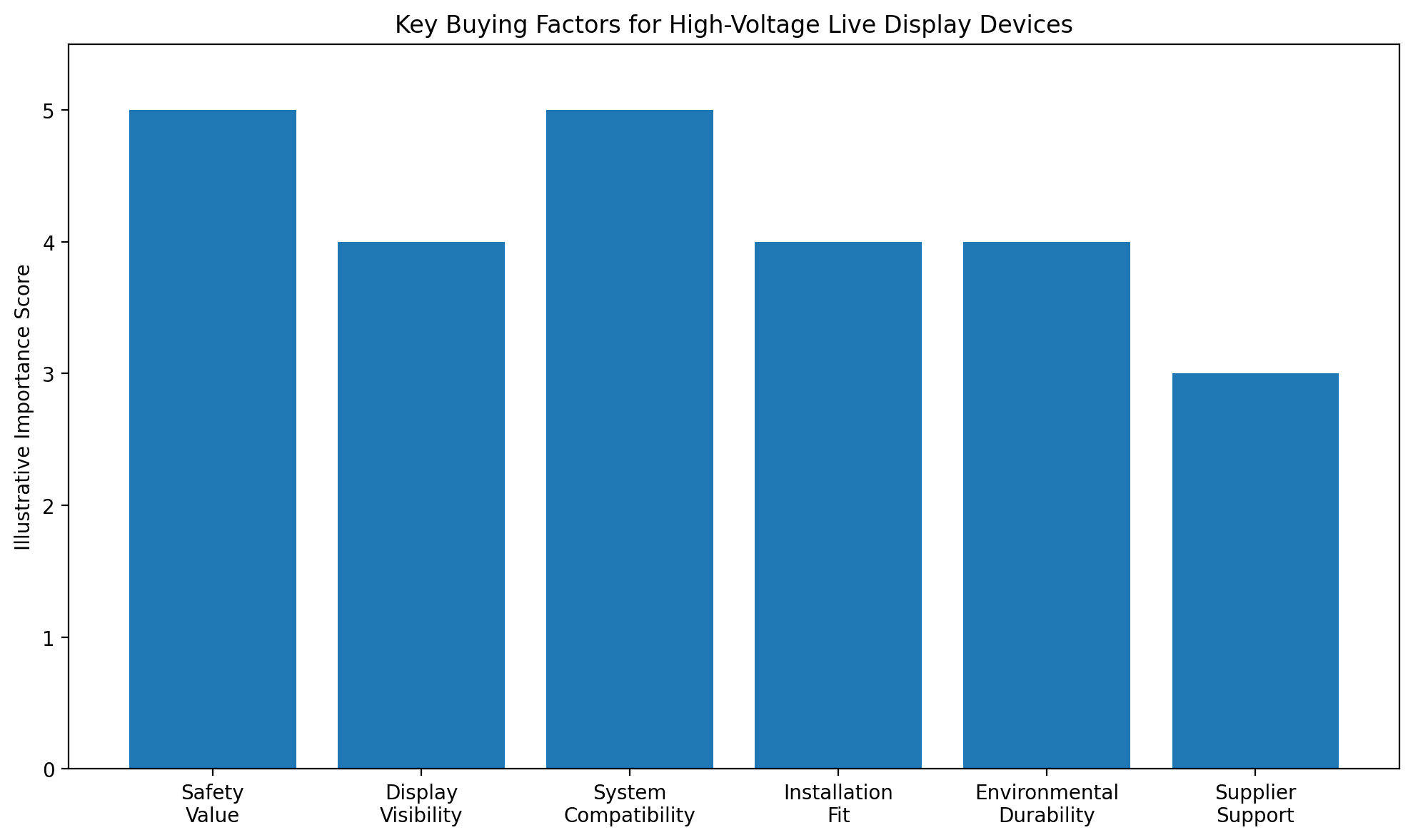
A High-Voltage Charged Display Device may be a small cabinet component, but its safety and purchasing value are significant. The right choice depends on more than voltage range alone. Buyers should also review function level, display visibility, system compatibility, mechanical fit, environmental durability, and supplier support. When these factors are checked carefully, the device can improve safety, reduce operating mistakes, and support smoother installation.
The best purchase is the one that matches the real application and delivers reliable long-term performance in the field. Hangzhou Liyi Electrical Equipment Co., Ltd. provides practical solutions designed to support cabinet safety, clear live-status indication, and dependable project use. For engineers, panel builders, and buyers, this helps create safer systems and stronger lifecycle value.
A: A High-Voltage Charged Display Device shows whether high-voltage equipment is energized.
A: It improves visibility, supports safety, and reduces operating mistakes.
A: Check voltage class, functions, fit, visibility, and compatibility.
A: Cost depends on features, structure, and project requirements.
A: Review panel size, mounting hole, wiring style, and supplier drawings.

